Showing posts with label Patoroch. Show all posts

12.12.2012

Flat Scenery

I was struck with this idea a month or so back, and it’s been gnawing at my mind ever since.  I would’ve shared it sooner but I’ve been having camera issues.

Also, a shameless plug.  My book 14 was named the best sci-fi book of 2012 by Audible.com (although it was also in the top fifteen books for Goodreads Best of 2012 in the horror category).  So, for this week only, my publisher’s knocked the price of the Kindle/ Nook version down to $2.99.  That’s 80% off the paperback price.  Plus, you can get the Kindle and audiobook version together for under ten bucks and do the Whispersync thing.  That's pretty much the classic "deal you can't beat"...

Anyway... Enough shameless shilling.  Back to our regularly scheduled topic...

I’ve always been a big fan of scenery.  As much as I have fun with the game itself, I just think there’s something really appealing about a miniature city or landscape that’s been carefully set out.  I know I sometimes drive my friends nuts as I tweak scenery pieces before the game to make more complete buildings or visible roads and alleys.  Back in the day, I made a few buildings from foam core and cardstock, but no matter what I did they always seemed a little... well, flat.  No matter how many window sills or buttresses I added on, no matter how much textured paint I used, they never had the depth of detail of real buildings.  When Games Workshop came out with their own building sets, it just pushed the bar for built-with-card scenrey that much higher.

Where am I going with this?

If you’ve been following this page or any of the other Paperhammer sites out there, you’ve probably heard the term flats come up a lot over the past year or so.  It’s when people try to build figures from cardstock, and they do it with various degrees of complexity.  Some are just cut-out images, but a few folks try to do a nice job layering their models to give them some depth and thickness.

It occurred to me, though, that there’s a wonderful place where flat figures and scenery overlap.  Those same flats can be used to create bas-relief images on a 40K scale.  They make it ridiculously easy to create rich detail and texture on buildings.

For example...

This rectangle is 3 3/32” tall by 3 1/2” wide.  In terms of the Games Workshop building sets, it’s two panels long and one high.  That’s a nice decorative fresco on a building.  Double that and you can make a mural that could easily be the width of an entire wall.

Helpful Hint – When I cut these rectangles, I’m not including the last “beam” of the panel.  I’ll add one of the loose beams from the actual sets to give this a bit more detail and authenticity.

I used this 3 3/32” by 3 1/2” rectangle as a base.  I ran a 1/2” strip along the base, then doubled that to give it some depth.  I added a 1/4” strip along the bottom edge for some detail, and then did a matching one along the top.  Once these were in place I wrapped this whole thing in wax paper, double-checked all the placements, and then let it dry under a heavy book or three for about half an hour. I don't want this to bend or flex as the glue dries.

Then I cut three strips that were 1/2” by 3 1/2” each.  These went on the flipside of the panel to give it a little more thickness and stability.  They’ll also make for a degree of detail on the inside, since all of the GW stuff is double-sided.  Again, I wrapped them in wax paper and let them dry under a stack of books.  It’s very important that the base be as solid and flat as possible.

Now, if you go here there’s a nice, layered set of flats for pre-Heresy Terminators (I think it’s an Eli Patoroch template, put I’m not sure—it’s in Russian).  That’s a good subject for an Imperial mural.  I could say it’s a Space Marine of legend like Captain Orar or perhaps Konvak Lann (my new favorite 40K badass).  Add enough details and it could even be a Primarch, although personally I’d feel odd about representing a Primarch with such a small mural...

Alas, these templates are a little too detailed and are intended to stretch into three dimensions, so the arms are all side-view.  This means my mural-figure is going to be a bit splayed, but I’m okay with that in a symbolic image like this.  If you’d really prefer the edge-on elements, jump over here and you’ll find some "modern" Terminator flats that use a forward view of the arms.

Helpful Hint—I didn’t use all the detail pieces from this set.  I think if this cardstock mural goes more than three or four layers deep (not counting the base) it’s going to get a bit thick and unwieldy.  Plus there’s more chance the glue will warp things.  So I did a bit of pick-and-choose to get the elements I thought would work best in four layers.  There might be something you like that I didn't use, depending on how detailed you want your bas-relief.

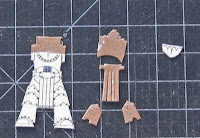
While the base was drying I started cutting out the components.  I used a new blade so it would be as sharp as possible and tried to make the cuts as clean as I could.  Don’t worry about all the fine detail that’s drawn on.  This is a bas-relief, so all we’re really worried about is the outlines and the edges.

Helpful Hint—By doing just one pass on the tabard with my knife (not hard enough to cut through) I made indents for the leather straps.  Easy bit of detail.

And this is getting a bit long so I’ll finish it up in a couple of days.

11.07.2012

Paperhammer Catalog

A quick bonus post for you...

There are some phenomenal Paperhammer templates coming out of Russia.  I’ve mentioned Eli Patoroch here before, but there’s really a couple folks over there who are all doing some plain amazing work.  It really has to be seen to be believed.

Which is why a couple of said folks got together with others in the online community and put together this little catalog.  It’s almost fifty pages of Paperhammer tanks, walkers, titans, and more.  There's even some life-sized bolters and lasguns.  If you still needed any proof of what you can do with this hobby, here it is, assembled (quite literally) by some of the cleverest people out there.

Keep in mind, the catalog is just images.  No templates, so this is more for inspiration than instruction.  However, you can find a big listing of Patoroch’s templates available here.  And there's always lots of stuff at the BWC archives on Yahoo.

2.10.2012

Infantryman's Uplifting Primer

Still buried in work.  New novella came out, new book is getting written out, meetings about the Amazon project.  Being a writer is nowhere near as fun as Castle makes it look.  Even if my girlfriend is just as sexy as Stana Katic.

While I’m running behind on actual projects, I thought it might be good to go over a couple basics.  A few notes on how I pick the models I want to build and some hints on how I put things together.

I guess the first thing is to be clear what this blog is about.  I admit, I’ve always leaned more to the hobby-fluff side of the game than the crushing-your-enemies-and-hearing-the-lamentations-of-their-women side of it.  I’m also, I can freely admit, on the less-disposable-income side of it.  Games Workshop and Forge World make some absolutely gorgeous models.  I don’t think there’s many folks here who wouldn’t have trouble spending a thousand dollars a year on Warhammer 40,000 products. 

Pictured Here:  Old One Eye
Which is kind of the problem, because it’s hard to deny this game is getting more and more expensive.  While I love playing it, it’s harder and harder to afford it.  And I really didn’t want to be one of those guys showing up with plastic tanks from an army set or dinosaurs for Tyranids or that sort of thing.

Fortunately, my old career in the film industry equipped me with a lot of skills for making things that look good for less money.  Once I became a full time writer, I tried to find even cheaper ways to build vehicles and utilize a lot of the spare bits we’ve all got kicking around.  And then I discovered the joy that is Paperhammer.

Now, I know there are some folks out there doing really amazing things with Paperhammer templates and plasticard, or custom-molding their own pieces from resin.  Those folks are just fantastic.  They can make a Rhino for ten bucks of plastic rather than a thirty dollar kit, or a Warhound for under a hundred bucks.  I am in awe of them and most of the stuff they do.  But that’s not what I’m doing here.

My goal is to do stuff as cheap as possible.  To work on projects anyone can afford.  I think the most expensive vehicle I’ve built to date has been the Plaguereaper, and most of that expense was the green stuff I used for the Pus Cannon.  I also sometimes do scenery pieces or cheap conversions, too.

Pictured Here:  Chaos Warhound Titan
Most of my Paperhammer projects are at least 90% basic cardstock that I harvest from cereal and frozen pizza boxes, held together with white glue you can buy at the supermarket for less than a buck.  That way everything’s very inexpensive.  It’s also very forgiving if you make a mistake.  One gouge can ruin a sheet of plastic.  If I ruin a sheet of cardstock... well, at the worse I’m waiting until Monday night when the lady and I make pizza and watch Alcatraz.  I also don’t feel bad about wasting cardstock if a template forces me to discard almost half the material because of odd shapes or angles.

On which note... I’m a big fan of simpler templates over more complex ones.  There are some people who do amazing templates.  One guy who consistently blows me away is Eli Patoroch, and if you haven’t seen his work, go check it out.  It’s fantastic.

However, I think as templates get more and more complex, they also require greater and greater skill.  I’ve seen some patterns that require over a dozen cuts and scores for a single detail piece.  While I think many of these make for fantastic models, they’re so overly complex they become very daunting for most people.

I also think there are a lot of times we get templates from people who figured out a CAD model and exploded it into a set of diagrams, but never physically built the darn thing.  There’s a wonderful story about how one of Mozart’s first compositions was technically perfect, but completely impossible to perform.  He’d written something that worked on the page, but it was too inhumanly complex for any musician—let alone an entire orchestra being led by a conductor.  I’ve seen that in a few templates.  They work on paper, but it’s clear their creators hadn’t stopped to consider the sheer number of cuts and folds it would require to actually build the models. 

A simpler template is easier to work with and easier to assemble (also easier to correct, which comes up now and then).  Also, as I hope I’ve shown here once or twice, it’s always possible to take a simple template and build something more detailed out of it.  A template that starts complex is what it is, and it’s harder to compensate or make adjustments as you go along.

(On a slight side note, as of late Patoroch’s started including figure flats in his designs as well.  His tanks come with a few Guardsmen, Chaos Renegades, Inquisitors—whatever’s relevant.  True to form, they’re a little more detailed than just straight flats, but in a much more manageable way.  His “flats” are very nice 3D models with four or five layers each. If you use flats, or have been considering it, you really must check his stuff out.)

I’ve also become a bit wary of partial templates.  The ones that always raise a flag are the ones that have things like “Make this shape x 24.”  It makes me wonder if this designer ever actually built their template, because the moment someone starts printing they’d realize how wasteful it is to make two dozen copies to get a piece the size of a matchbook.  And if they haven’t built it... well...  I’ve found the good templates have everything you need on them, even all the multiples.  At the least, they’ll have all the multiples grouped on the same page.

Finally, I like to build stuff for my armies, but I also just like stuff that looks cool.  I don’t know if I’m ever going to use the Hellblade or my Nurgle Defiler, but I sure like the way they came out.

And that’s what I’m all about here.

Two weeks, tops, I’ll be back on my regular schedule and finish up the Silver Towers.