9.10.2013

Underhive and Underbudget

So, some of you longfangs here might remember Necromunda.  It was one of the older Games Workshop side-games that was more-or-less Warhammer 40K but with gang warfare instead of planetary battles. Normally you’d control an army, in Necromunda you’d just control seven or eight individual models.   GW tried to bring it back a few years ago, but as far as I can tell it never really caught on (or got much support).  Rumor has it that the new Inquisition game is going to be a tighter, more Imperium-centric version of Necromunda.
           
Then again, rumor also said we’d be getting a plastic Warhound a few Christmases back...
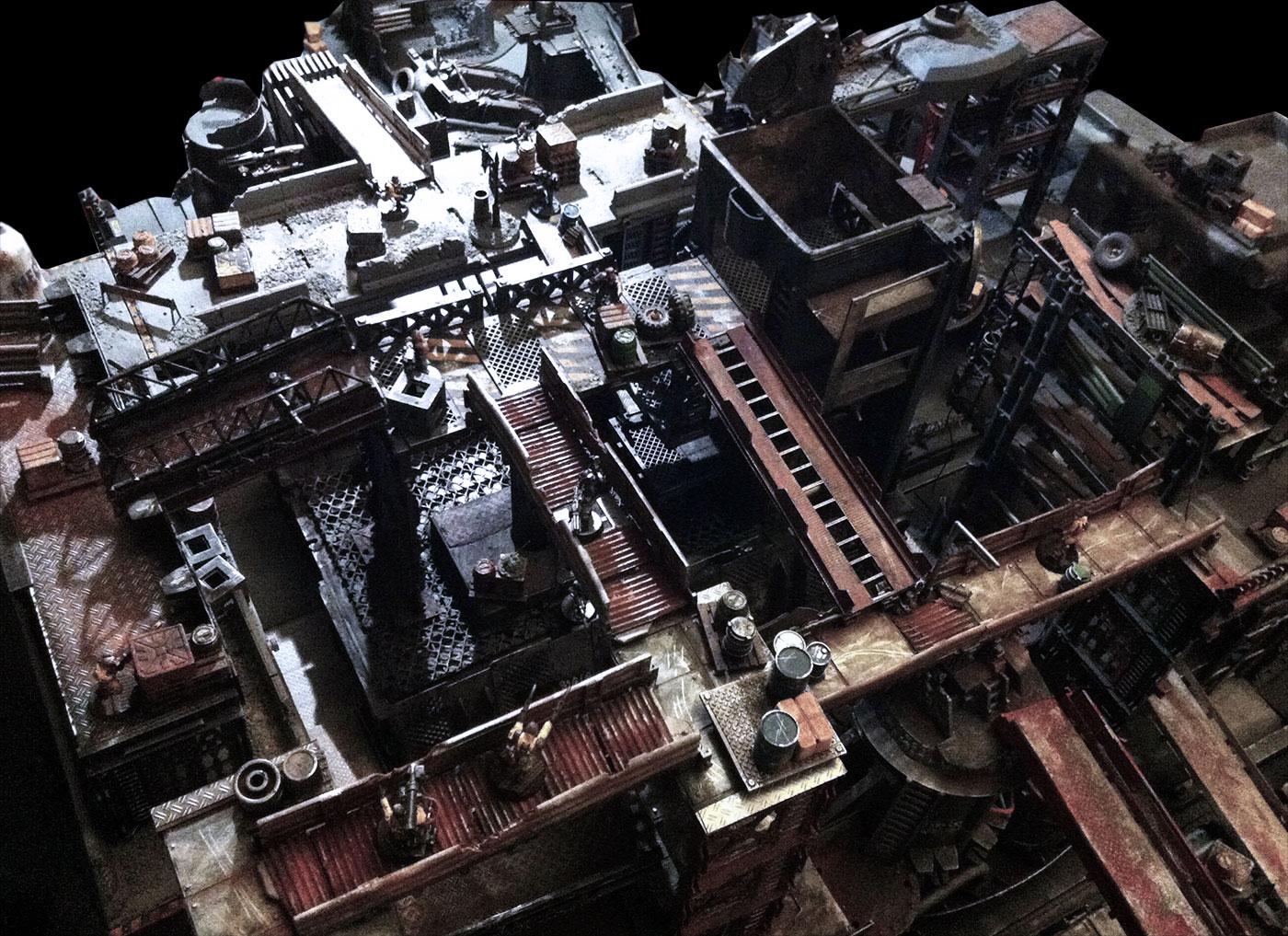
           
Anyway, one of the defining traits of Necromunda was the dense scenery.  The new 6th Edition rules of Warhammer 40K really allow for some neat stuff with denser game tables, too.  So my friend Marcus had been playing around with a few mission ideas in that vein.  A few weeks back he invited a few of us over one night to watch bad Sy-Fy movies, have a few drinks, and build a bunch of scenery.  My job was to help make it look as good as possible for as little as possible.
           
Most of what we used were just old containers that were heading for the bin.  Oatmeal, fish food, some random nut containers, stuff like that.  Almost anything made of mostly cardboard would work for this.  We also had a few cereal and pizza boxes to use for raw cardstock where we needed it.  And we had a few plastic bits as well, like cat treats and yogurt drinks. 

For tools, the only semi-exotic things we had were Ms. Gillian’s hot glue gun and my own 1/16” hole punch.  You may remember I use said punch for rivets, which add a huge level of texture and detail for minimal effort.  Everything else was done with scissors, white glue, and your basic hobby knife. 

The first step was just fastening containers down onto some bases Gillian had cut.  There wasn’t a lot of planning here, just grouping things together in ways that looked vaguely industrial.

Then we added some broad details.  Squares and rectangles make great panels.  I’d give them a slight curve with the handle of my hobby knife and then glue them in place.

Helpful Hint—Putting panels in the same place on multiple pieces gives a standardized, manufactured look.  It’s one of those tiny, subtle touches that’ll stand out. 

Once I had a bunch of panels in place, I added rivets to them.  I tried to space them evenly—again, to give it that standardized look. I've found on a project like this, the best thing to do is have a pile of rivets pre-punches and a small blob of white glue.  I use the tip of my knife to put a tiny drop of glue wherever I want the rivet, wipe it off, and then use the tip to put the rivet in place.  I hold it in place for five or six seconds and then move on to the next one.  Once I've got it down, I can usually do four or five rivets a minute.  These towers took about twenty minutes.

Helpful Hint – An easy way to add quick detail is to just apply rivets around an existing shape.  On most food packages you’ll find a logo, a nutrition block, or a bar code which sits very square with the rest of the package.  Just line that rectangle or square with rivets.  When you paint over it, you’ll suddenly have a bunch of texture on the flat surface.

Of course, you could also go Orky with a lot of this and just add panels and “patches” at random.  If you work the cardstock a bit, it’ll get soft and you can even have two patches overlap.  Depending on if your scenery is supposed to be Ork-built or something they’ve adopted as their own, you may want to have something more manufactured as a base layer of detail and then add Orkiness on top of it.

Marcus had a few random tubes, pipes, and other scenery bits.  Those got hot glued on here and there, but we went pretty light on them overall.

And really... that’s it.  Four of us spent a little over three hours and built eight or nine of these pieces.  That’s enough to fill a good chunk of a battlefield with dense urban terrain, and most of it came out of the trash.  

9.02.2013

Ogres to Ogryns, Pt 2

Well, this only took a few months.  More like half a year.  Pathetic, isn’t it?  Sad as it is to say, these guys have been sitting half-done on my cutting mat the whole time.

So, the basic bodies are done.  What I need now are weapons.

The ripper guns weren’t that hard.  I wanted to stick to the combat shotgun idea from the Imperial Guard codex, but I didn’t have a problem with them looking a little simplistic and Ogryn-friendly.  My previous Ogre-Ogryn conversion (for my Penal Legion) had used the autocannon magazine on the side, but I wanted to see if I could make something that looked more like an industrial Thompson sub-machine gun.

The most notable part of a Tommy gun (and a ripper gun) is the ammunition drum.  I played around with a few ideas, including building the drums from scratch.  What I finally decided on was gluing together a pair of old Fantasy shields.  It gave a size and depth to the drum that I liked, plus some tiny details around the edges.

The main body/barrel of the ripper gun is 3/16” tubing.  I cut a 1/4” section and then a 1/2” section.  These would go on either side of my magazine.  On the shorter, back half, I also added a wheel hub to serve as a machined-looking butt to the weapon.  


Then I took some 1/8” wide plastic and cut a 7/8”strip.  This would be the top of my ripper gun and help tie the whole thing together, both  visually (it helps hide the fact that a few of the front and back pieces don’t line up perfectly) and structurally (it was going to serve as a sort of spine for the next bit).  I lined it up to the back so any excess hung out over the end of the barrel.

I made a few 1/4” squares and put them on either side of the rear section, placing them so they “connected” to the top strip.  This gave a bit more bulk to the body of the ripper gun.  I put 1/4” x 1/8” pieces on the front, also lined up with the top strip and butting up against the magazine.  It gave the whole thing a nice, solid look.  I finished it off with a thin strip along each edge and a 1/16” strip along the top.

The last touch was to cut a 3/8” piece of 1/8” tubing and slide it in the front of the ripper gun to give it a muzzle.  I left 1/8” sticking out and filed it a bit to make it perpendicular to the barrel.  I toyed with the idea of putting iron sights on the front of the muzzle, but for the moment I’ve decided against it.  Since ripper guns are made exclusively for Ogryns, I can’t see them being manufactured with any level of accuracy in mind.  I may change my mind at the last minute before priming, though.

Next step was to mount the weapons on the Ogryns.  The Ogres come with a lot of large, square blades that look a lot like machetes, and I like that look for Ogryns who were going to be in the jungle.  Since those blades are all right-handed, I had the choice of making all the ripper guns left-handed, or doing a lot of modeling work to switch everyone’s hands around.  I decided to stick with machetes on the right, rippers on the left—mostly because I like how this works with a lot of the arm poses (which are pretty inflexible on the Ogres)

(keen-eyed readers may note one of those is a right hand.  I did a cool knife bit with the Ogre musician hand, so I had to put that ripper on the opposite side.  The other option would’ve been having it slung over said Ogryn’s shoulder, but that would’ve involved building a sling and a trigger mechanism and, well, I didn’t want to do all that and have it come out half-assed.  Plus it’d leave me with the oddness of what to put in the other hand...)

I cut the weapons away from the hands and filed them flat above and below the fist.  I tried to make sure the flat sections were parallel, so I could add a base to the grip (just a little square of plastic) that would line up.  This is one of those subtle little things that can really gnaw at you if you get it wrong, and it’ll take forever to figure out why.

Helpful Hint – I attached the fists to the bodies before I attached them to the weapons.  Most of the Ogre arms are tight against the torso and I didn’t want to risk attaching the hand to the weapon at a point where it would prevent me from attaching that whole assembly to the body.  So hand to body and then weapon to hand.

Ogryns get frag grenades, but all the standard grenades look ridiculously small on them.   So I tried to think what a group of near-feral abhumans would use.  Oh, sure, they might just use oversized frag grenades, and I even had an Inquisitor-scale grenade, but I thought it’d look a little weird to only have one model in the squad with a visible grenade.  Plus, I wanted something that would sell their borderline bestiality with something a little more fun.

As it turned out, the answer was right there on the Ogre sprues.  Bear traps.  They’re big, primitive, fit into the jungle setting well, and... well, let’s be honest.  They work as frag grenades.  If someone throws half a dozen open bear traps at you, you’re sure as hell going to put your head down.

I also added a bit of random greenery from different Fantasy sets onto the bases.  Especially for a jungle-themed army, I find the big empty swaths of base are kind of distracting.  I find these leaves and weeds all the time in the bitz bins (I think they’re from Wood Elf sets, or maybe Dryads), and this is a great use for them.

I tried to pick some of the less-crazy Ogre heads.  Even so, I filed down a lot of the weird bumps and pins on their heads.  I’m toying with the idea of using a little bit of green stuff and making simple bandanas on them.  It would tie them to the Catachans even more... and also give me some more time to consider those iron sights.

But, there they are.  A good-sized squad of Ogryns for about a third the price it would cost to buy as many actual figures.  If I’d been able to work on them straight through, this was maybe three days of non-intensive work.  I might toss up a picture later once they’re primed and have some basic colors on them.

Next time (which will be, I swear to God, in one week) I’ll show you how some friends and I whipped up a bunch of good-looking, dirt cheap scenery in just a few hours.

7.09.2013

The Ferrari Mentality

I know, I know. I’m so ridiculously behind here.  I do have some pretty good reasons, though, so I’m hoping you’ll cut me a little slack.

I jumped back here for two reasons.  First, shamelessly, is to promote the new book release.  Broadway Paperbacks just released Ex-Communication today (third book in the Ex-Heroes series).  It’s available at your local bookstore, Amazon, on the Kindle, at Audible.com... everywhere.  Check it out.

Second is to rant a bit about a phrase I see popping up again and again, usually to explain (or excuse) Games Workshop’s prices.  Because they’re really getting kind of crazy.  I originally started this page because I was a struggling writer who couldn’t afford to pay GW prices when I need to pay rent.  Well, paying the rent’s a lot easier now, but—as much as I love it—I’m still not sure I can afford how much this game costs.
  
Anyway, the phrase in question is “the Ferrari of miniatures games,” or some variant on it.  If you follow this hobby on the web (and you’re here, so I’m guessing you do), you’ve probably seen this idea expressed one way or another.  Simply put, Games Workshop feels like they’ve got the best products which carry a certain prestige and status to the owner, and that warrants the highest prices—much in the same way a Ferrari costs so much more than a Volkswagen or a Kia, despite having all the same basic parts made from all the same materials.

See, there’s one huge problem with this idea, though.  And it’s the one GW—and most of us—tend to overlook because it reflects on us.

Everyone knows what a Ferrari is.  Everyone knows what it’s worth.  Everyone knows it is a high point, if not the pinnacle, of automotive ownership, and almost half the people in the world own cars.

Let’s repeat that word, because it’s important.  Everyone.  Not just the girls at the club or the guys at the office.  If I drive a Ferrari through a village of huts in Africa or a six-building town in the Australian outback, people there are going to point at my car and go “Holy Crap!  A Ferrari!  Here!  Holy crap!”
           
A Ferrari is a status symbol because of this universal recognition.  That’s how being a status symbol works.  Something can’t be “the Ferrari of X” unless X is also something universally known and recognized.  You could have the Ferrari of shoes or refrigerators, but the Ferrari of mellonballers is just kind of silly (no matter how beautifully designed that mellonballer is).  Something just can’t be that kind of status symbol if 99% of the world doesn’t use it or holds it in a poor light.

For example... little toy soldiers.

If I try to impress the girls at the club with my pro-painted Dark Eldar models, I feel safe saying I’ll be going home alone that night.  If I bring up my phenomenal Demon Prince conversion during my performance review at the office, it probably won’t improve my chances for that promotion.  And if I show up in that African village or Australian town carrying an armload of Space Marines, odds are I’m going to learn lots of colorful local terms for “geek” and possibly also “weirdo,” “man-child,” and maybe even “loser.” 

I don’t say this to be cruel, just straight-forward.  All of us here are a lot of grown men and women who play with little toy soldiers.  The vast majority of the planet’s population does not see this as something to be incredibly proud of or as a huge plus in the personality/ life choices departments.  I can try to spin it anyway I like, but that’s the simple truth of things.  I’m okay with it (hell, I also like LEGOs and I write about superheroes fighting zombies for a living), but I’m also under no illusions about it.  We're a minority.

See, that’s why this whole Ferrari mentality (and business plan) doesn’t work.  People are willing to pay huge sums of money for a Ferrari because everyone, everywhere knows what owning a Ferrari means.  Not to sound crass, but people get sex out of owning Ferraris.  Yes, even today. 

And that’s never going to happen with little toy soldiers.  No matter how crisp the lines are on those highlights, owning a box full of Game Workshop Fire Warriors and Crisis Suits is never, ever going to be a status symbol.  Which is why this mentality—and pricing system—really can’t be applied to them.

The whole idea of “the Ferrari of little toy soldiers” is just... well, stupid.

So, in conclusion, please buy my books so that I can afford a box set or two of toy soldiers this year.


Or maybe even a Ferrari.